BBTL
- Details
Original article by former CPTA secretary, Cameron Little, 2008.
Chance, choice and circumstance all played a part in the successful campaign to reconnect Alloa to the national rail network on 19 May 2008.
Since the rail link to Alloa was lost in the 1960s many people campaigned to have it reinstated. On 19 May 2008, regular scheduled passenger trains recommenced.
Previous campaigns identified the benefits of a rail link, but the political will was not there to allow them to succeed.
To find out what sort of sustainable transport local people wanted, Clackmannanshire Council took the unusual step of setting up a Civic Commission on Transport to hear what local people wanted.
In early 1999 an invitation dropped through my letter box from the Chief Executive of Clackmannanshire Council headed ‘Your Chance to Stand Up and be Counted!' The letter said that Clackmannanshire Council was looking for 16 local people to be part of a Civic Commission on Transport: and that my name had been chosen at random. I soon received further details on what the Civic Commission was expected to do.
The work involved: sitting for four days, interviewing expert witnesses, visiting various sites and discussing and reviewing transport needs. The findings were to be reported to elected members of the Council on how travel opportunities could be improved.
At this time Clackmannanshire was the only Council area in Scotland with no rail services. It was my opinion that if the rail link were to be re-established this could only benefit the area.
During the proceedings I raised this issue and enquired if there was any possibility of rail services returning. The replies I received from some expert witnesses were not very encouraging. The representative from the bus company was of the opinion that a rail link, were it to be rebuilt, would be unwelcome as direct competition.
Council policies presented the rail link as something for the future. At the end of the four day event, the Commission recommended that rail travel should be a goal that the Council should pursue actively.
Around six months later I received a phone call from informing me that the Council was interested in promoting the case to reopen the rail link and suggesting that I might take forward the work of the Commission by fronting up the local community campaign. I did not know what to do to organise a campaign but, help was at hand. The Council agreed to provide secretarial support and an information leaflet asking the general public if they would support the return of a passenger rail service to Alloa. This was issued at various points around the town, such as the library and Council offices. Soon a flood of mail supporting the campaign arrived and a meeting was held to determine campaign roles.
The Earl of Mar and Kellie was elected Chairman and Martin Cook, Vice Chair. I became Secretary. Other’s such as Judy Barron agreed to provide help and my wife helped by proof reading letters and other publicity.
It was decided to call the campaign the CPTA (Campaign for Passenger Trains to Alloa). The Earl proved to be of great value as Chairman as he sat in the House of Lords, where was able to promote and further our case. Initial contact was made with the local papers and the Wee County News established ‘Back on Track’ as the strapline for promoting the rail scheme. Competition between the local papers ensured that the Alloa Advertiser also gave us additional publicity so the rail project was in the news virtually every week.
I researched how other rail campaigns had been carried out including reading the story of the successful campaign to save the Settle and Carlisle Railway. A letter was sent to all MSPs to ask for their support. Again the response was very positive with MSPs from all parties writing to us with their support.
We set about the task of encouraging the politicians in power to provide funding for the project, which had now been costed by Railtrack and Scotrail. The Councils’ first application to the Scottish Executive failed to attract any funding from the national Public Transport Fund, but it was asked to re-submit for the next round the following year. We carried on with more resolve and determination than ever.
The fact that Clackmannanshire was served by Councillors, MSPs and MPs from every party made it far easier to pursue our case. After numerous letters to various MSPs, Nick Johnston invited us to meet with a group of them. The meeting proved to be of particular value since it also created pressure for Clackmannanshire Council themselves to clarify their own financial commitment to the project. In the months that followed the Scottish Parliament was the location of regular visits for campaigning and meeting MSPs.
In November 2000, Sarah Boyack (then the Minister for Transport and the Environment) announced at a meeting in Alloa that the Scottish Executive was willing to back the project and committed six and a half million pounds to get it started.
However around six months later an announcement was made by Railtrack that the costing for the project was inaccurate, and that their revised figures were in the region of around twenty three million pounds. The whole project’s future was put in doubt. Nevertheless amongst fears that it would be cancelled the campaign carried on. However, as the scheme design and legal process continued there did not seem to be much for the campaign to do. However, in 2003, the Council received the first copies of the Stirling-Alloa Railway Bill from George Reid, the MSP for the Ochil constituency and Presiding Officer of the Scottish Parliament.
A Private Bill Committee was set up to scrutinise any objections to the scheme. This was held in Alloa and received submissions from objectors such as land owners and house owners on the line side, especially in the Clackmannan area. The CPTA submitted a letter of support to the Parliament’s committee and again contributed to the debate in the local press. Eventually all objections were dismissed and the Bill was passed, leading to the eventual start of reconstruction of the railway.
Other circumstances had influenced and benefited the campaign. The flooding of the Longannet mine complex meant that more imported coal had to be hauled to the power station by rail, and with demands growing both on the Edinburgh/Glasgow corridor and the route over the Forth Rail bridge, extra capacity was needed using the line via Alloa.
The reconstruction of the line took longer than we thought and cost much more than we hoped. However, from now and for years to come, its true value will be realised by the communities of Alloa and the surrounding area. I am very grateful to all who were involved in making it happen. By ‘standing up and being counted’ in 1999. I certainly played my part.
Summary
The Campaign for Passenger Trains to Alloa was formed in 1999, and was dissolved following successful completion of the SAK railway project.
Consisting of a small team of interested individuals and in conjunction with several authorities they were able to provide a positive and constructive viewpoint towards the re-opening of the Stirling - Alloa - Kincardine stretch of the railway.
Starting in September 2005 the Stirling - Alloa - Kincardine (SAK) railway project was completed in 2008.
The line was re-opened in 2008 at a cost of around £85 million and has proved to be a very successful investment.
References:
Extracted and adapted from "From Civic Commission to Rail Campaign" by Cameron Little, CPTA Secretary.
First published in full in the Scottish Transport Review - Issue 40, 2008.
- Details
Establishing the railway
During the mid - 1800s a train boom was in full flow. With the existing road infrastructure being in poor repair, everyone desperately wanted a train service in their town.
The Stirling and Dunfermline Railway
For the Stirling and Dunfermline Railway, this boom took root via the Edinburgh and Glasgow Railway Company, who wished to get access to the mineral deposits along the line of route, but also as a tactical measure to keep the rival Caledonian Railway (who had a railway to Stirling in partnership with the Scottish Central Railway) out of Fife. There were serious difficulties at the time of opening about securing a commitment from an operator to lease the railway, but it finally opened fully to Stirling in 1852.
This railway took the route west from Dunfermline Upper Station (1849 to 1968), out past Milesmark to Oakley (from 1850 to 1968), East Grange (1850 to 1958), Bogside (1850 to 1958), Kincardine (later Forestmill) (1850 to 1930 / 1979(freight)), Clackmannan (Clackmannan Road) (1850 to 1919), Alloa (1850 to 1968), Cambus (1852 to 1968), Causewayhead (1852 to 1955) and on to Stirling (1848 - present).
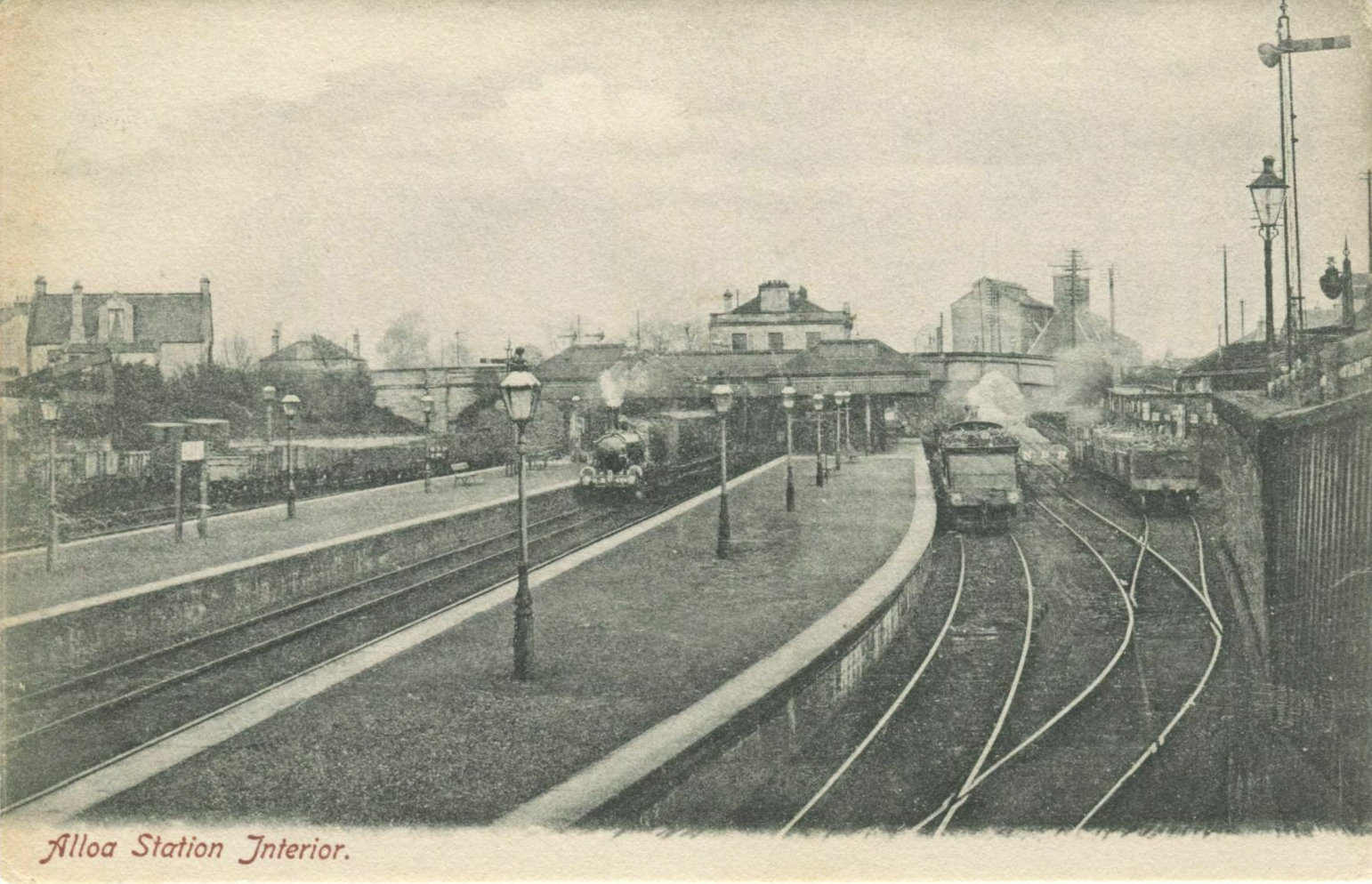
The original Alloa Station (1895) - Archive photo
The line was originally opened with the main purpose of moving minerals such as coal and ironstone, which it did on several stretches until the last freight services ceased in the 1980s.
The line from Dunfermline Upper Station to Kincardine Junction near Clackmannan was eventually removed and much of the track bed was converted into a cycle path. Dunfermline Upper Station was itself demolished and redeveloped into a retail park.
Back in the late 1800s though, the rail boom was still going well, and by 1865 the Stirling and Dunfermline railway had become part of the North British Railway's holdings.
The Kincardine Branch
In 1893 the North British Railway built a rail link from Kincardine junction via Clackmannan and Kennet (1893 to 1930) and Kilbagie (1894 to 1930) to Kincardine (1893 to 1930). This was named the Kincardine Branch.
A branch line from Alloa to Kincardine was not enough to satisfy the demands for a better railway service in the area, and connecting Kincardine and Dunfermline was proposed.
The Kincardine and Dunfermline Railway
The Kincardine and Dunfermline Railway was the result, authorised by the North British Railway (General Powers) Act, 1898. It was to leave the Dunfermline to Charlestown line at Meadowend and then run by Cairneyhill, Torryburn and Culross to meet the end of the existing Kincardine branch at Kincardine Pier.
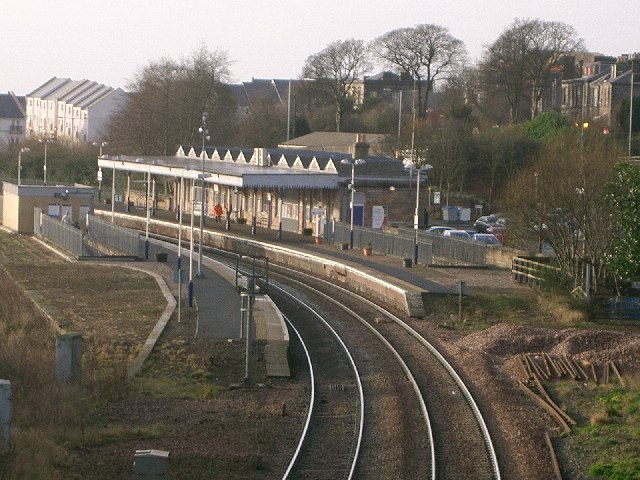
Dunfermline Town Station (2005) - Paul McIlroy
The stations and towns along this route were Dunfermline Comely Park (later Dunfermline Lower, now Dunfermline City) (1877 to present), Cairneyhill (1906 to 1930), Torryburn (1906 to 1930), Valleyfield, Culross (1906 to 1930) and on to Kincardine (1893 to 1930), Joining the Kincardine Branch line to allow through traffic to Alloa and Stirling.
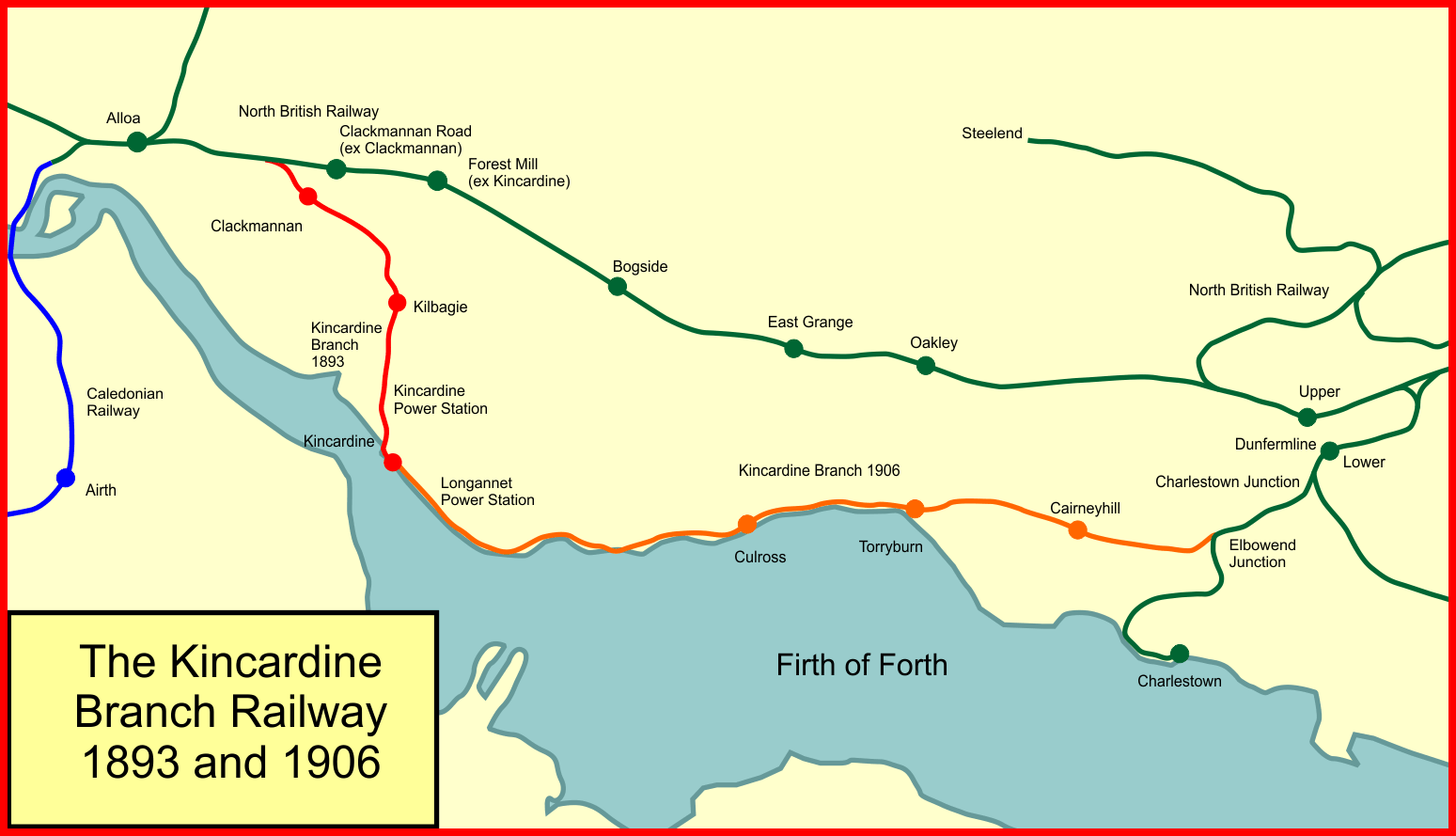
Map: Wikipedia
Key:
Red - Kincardine Branch
Orange - Kincardine and Dunfermline Railway
As with the Stirling and Dunfermline line, the priority was for freight traffic on the route, and subsequently only four passenger trains ran each way per day weekdays and five each way on a Saturday. The infrequent service led to lower than required passenger use, and with the Railways Act 1921 reducing competition and amalgamating hundreds of rail companies to reduce costs, almost inevitably the line closed to passenger traffic in 1930.
The line remained open to freight traffic from Dunfermline to Kincardine, but the passenger stations and superfluous infrastructure were demolished or removed.
So by 1968 there were no passengers travelling between Dunfermline and Stirling other than by bus or car. With deregulation of bus services via to The Transport Act 1985, bus services have seen a continual decline over the intervening years, to a point where car ownership has almost become a necessity in West Fife and Clackmannanshire.
The campaign to re-open the line
Against this backdrop of declining connectivity, a campaign was organised to see the Stirling to Alloa rail link re-established. This, along with an urgent need to pull coal to Longannet Power Station from the west coast, helped in the development of the Stirling / Alloa / Kincardine railway project, with work starting on the ground in 2004. The project opened fully in 2008, with passenger traffic commencing from Alloa to Stiling and on to Glasgow, which has been a great success. That story is for another page.
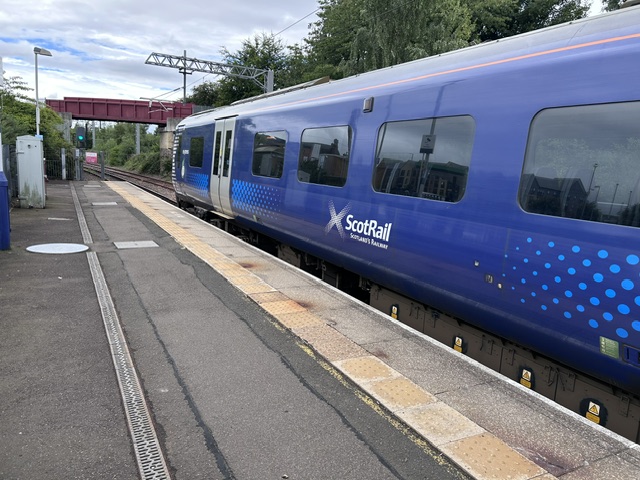
Train getting ready to leave the replacement Alloa Station, August 2026 - Cameron Little
References :
Wikipedia : Stirling and Dunfermline Railway
Wikipedia : Kincardine Line
Legislation.gov.uk : Railways Act 1921
Legislation.gov.uk : Transport Act 1985
Geograph.org.uk